For airport restaurants
We work in your terminal. We never reach your counter.
Flight crews, gate agents, ramp, TSA — thousands of us walk past your restaurant every shift. A 25-minute break doesn't survive the line, so we skip the meal, and you never see the order.
So we built CrewEats — now your food reaches us, timed to our schedule. It works the way we do.
Your menu, your prices, your POS. No build-out, no new hardware.
The operator's math
Every square foot here has to work twice as hard.
You already know this part. Airport space is some of the most expensive real estate in hospitality, build-out is a capital project, labor is scarce, and the rent tends to move with your sales. Growth has to come from the footprint you already have.
$450–$2,000
per square foot
What it costs to build airport F&B space. Every extra seat, every extra line, every extra square foot of capacity is a capital project.
~80%
annual turnover
With restaurant turnover running near 80% a year. You can't answer a demand problem by adding people — you're already fighting to keep the ones you have.
Rent follows sales
percentage rent · MAG floors
Minimum guarantees, percentage rent above them, and an agreement you have to justify at renewal. Revenue per square foot isn't a metric here. It's the whole game.
And the passengers are leaving the concourse
Lounges are pulling your best customers off the floor.
Amex, Capital One, Chase, the airline clubs — premium lounges keep expanding — and an hour a high-spend passenger spends upstairs is an hour they aren't spending on your concourse. Industry figures put global lounge visits up around 31% in 2024, growing considerably faster than air traffic itself, with food and drink at the top of why people go.
So the squeeze runs both ways: capacity you can't cheaply add, and demand quietly walking upstairs. Which leaves a question worth two minutes — where does another dollar per square foot come from, without another square foot?
Where the next dollar comes from
We're already inside your terminal.
Gate agents, ramp crews, TSA, concession staff, based and transient flight crews — thousands of us working inside your food program every day and eating almost none of it, because a break doesn't survive the line. No new square footage required. We clock in every day.
25 min
A typical break
Deplane, walk, queue, wait, walk back. Most days it doesn't fit — so they don't try.
365 days
No season
They're behind the badge on a wet Tuesday in February. This volume doesn't track the travel calendar.
Every shift
Repeat by default
The same people, the same terminal, the same hunger, five days a week.
0
Can use a lounge on shift
Badged workers have nowhere else to go. Their spend stays on your concourse.
See how much CrewEats can add.
Pick the size of your field and move the sliders. This is arithmetic, not a promise — but it's the same arithmetic we put in front of airport operators, and every dollar in it comes from orders that aren't being placed today.
Your airport
A large hub with based crews and a full concession program. Sets the starting workforce — slide it to yours.
Based crews, transient crews and badged airport employees working the field.
10,000 people ordering.
How often an active user orders during their working week.
Full ticket through your own POS, at your own menu prices.
Monthly
$3.3M
Year one
$39.0M
Five years
$351.0M
This is the crew and employee food spend at a field this size — the pool your terminal's restaurants compete for, not one outlet's revenue. Illustration only, not a forecast, a guarantee or an offer. Assumes the workforce, adoption, frequency and order value set above, with adoption rising 10 percentage points a year. Airport sizes are round anchors, not published headcounts for any specific airport.
The restaurant dashboard
Three outlets. Three terminals. One login.
Run one location or fifteen. Link them all under a single account, then drop into any single store when a number looks wrong. Your entire operation on one screen — transparent reporting on every CrewEats order.

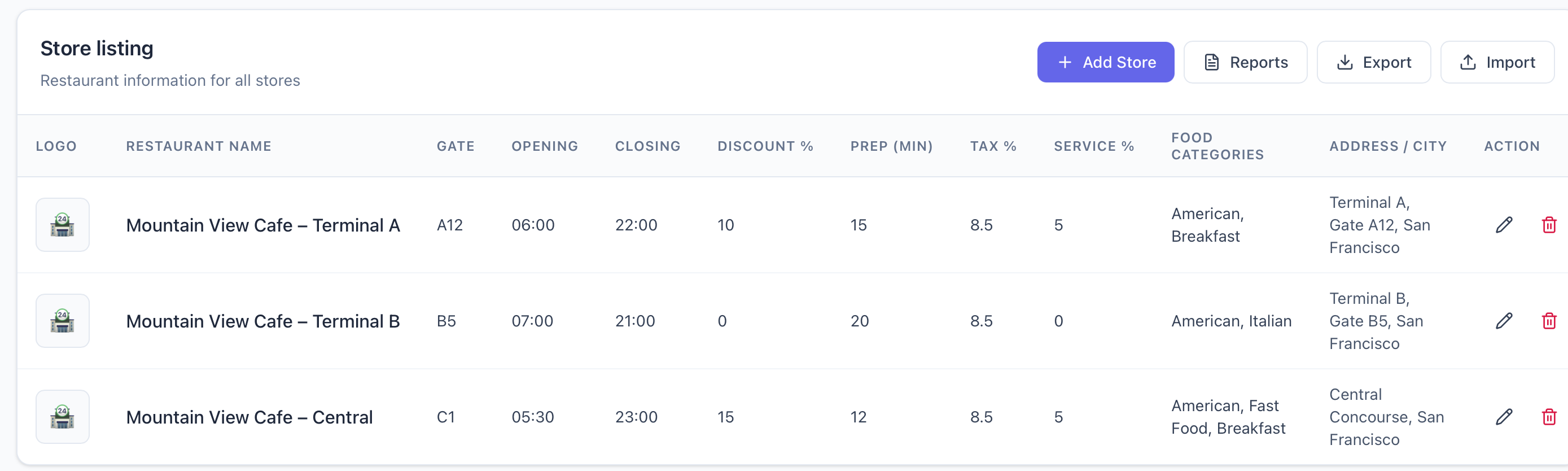

Sample data shown.
Every order, itemized
Revenue, tickets, customers, deliveries, and the split between pickup and delivery — per store and across the whole network.
Nothing hidden
You see what we see. Cancellations and incorrect orders arrive with the reason attached, not just a count you have to argue about.
It comes with the partnership
Reporting isn't a paid tier or an upsell. If you're on CrewEats, the dashboard is on from day one.
Beyond reporting
It doesn't just tell you what happened.
Airport demand isn't flat. It moves with the operation — and the operation is knowable. The dashboard learns your pattern and turns it into something a shift manager can act on.
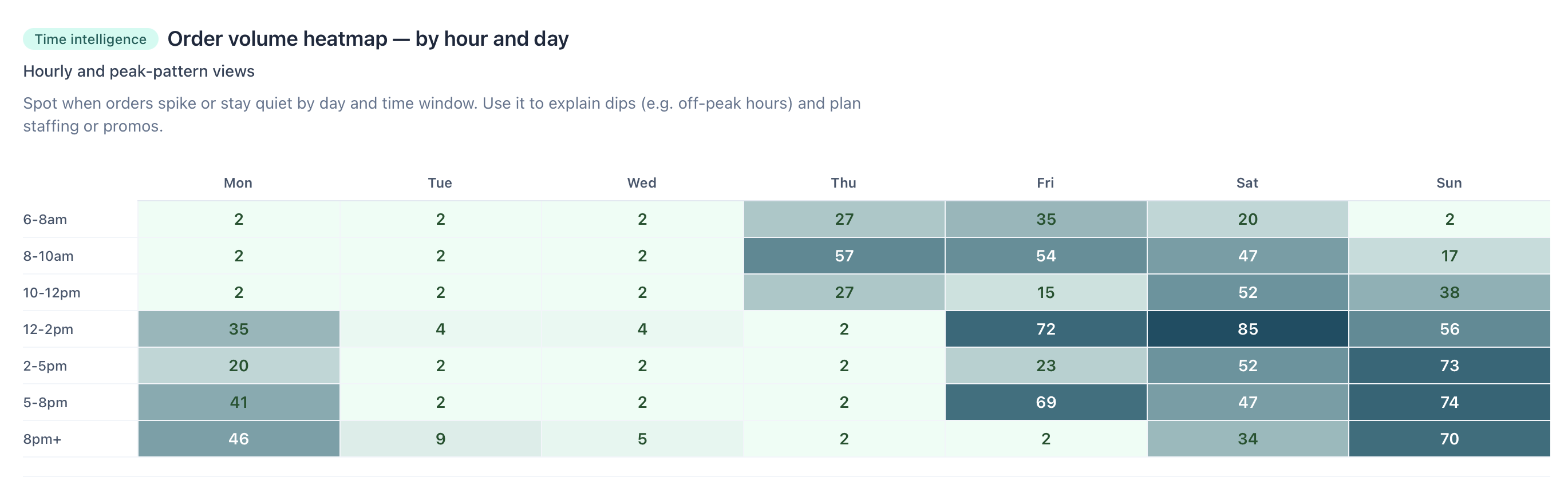
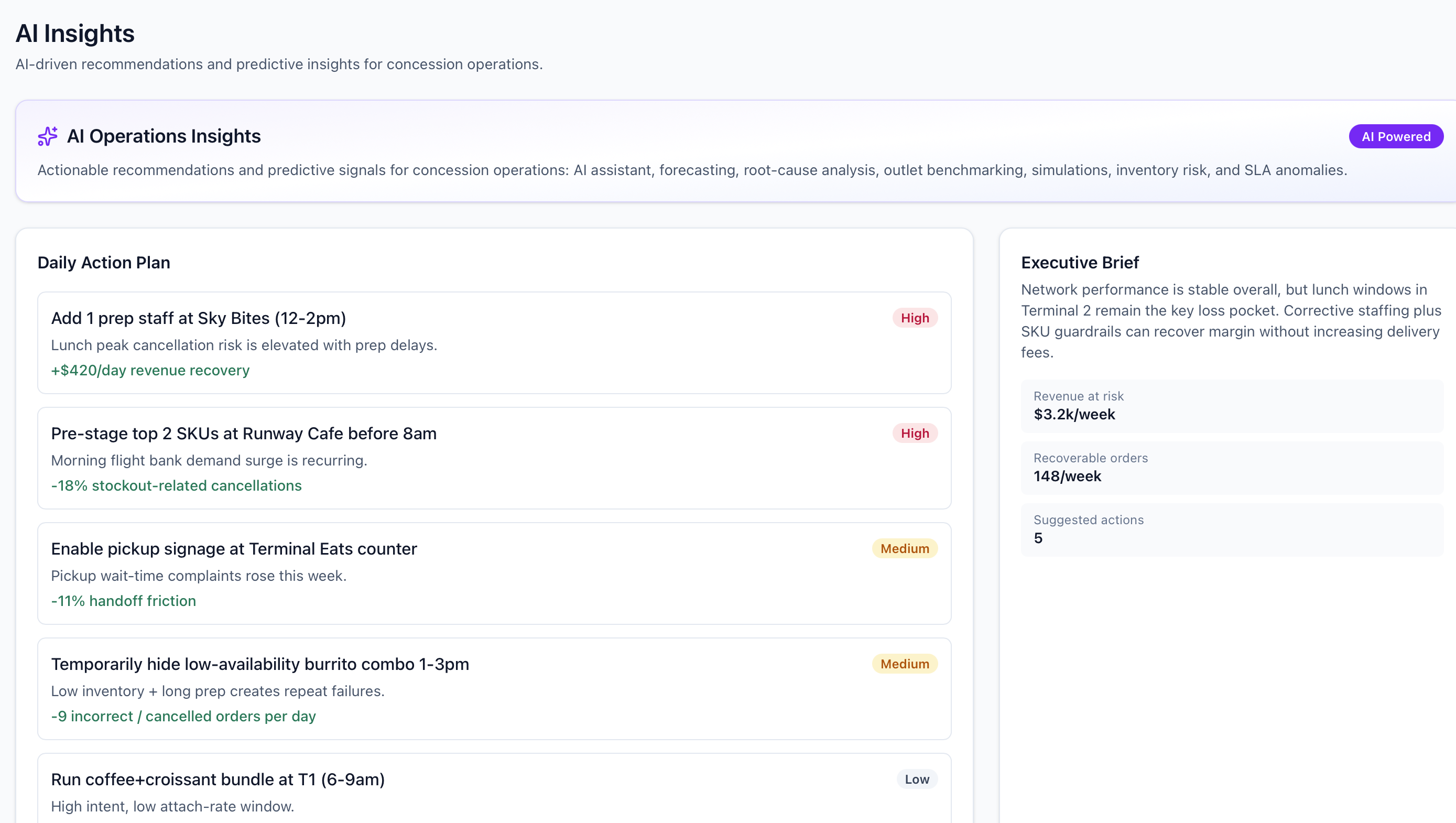
Sample data shown.
Know the peak before it lands
Order volume by hour and by day, so prep and rota follow the real curve — flight banks, shift changes, break windows — instead of last month's guess.
A short list, not a spreadsheet
Concrete moves with the money attached: pre-stage two SKUs before the morning bank, add a prep line at noon, hide the item that keeps failing.
Answers, not just charts
Why cancellations rose this week. Which outlet is losing lunch. Plus AI-powered what-if scenarios — model a change before you make it and see what it does to your sales.
What changes in your kitchen
Almost nothing.
Think of CrewEats as your kiosk, in every crew member's and employee's hand. We handle the logistics. You get the sales.
More tickets is more work — we won't pretend otherwise. But it's the work you're already set up to do, arriving through the channel you already use.
A kiosk in every hand.
You already run kiosks. This is the same kiosk-to-POS layer your IT team knows — except the screen is a phone in a crew member's pocket, out at the gate, on the ramp, in the ops office.
Nothing to build.
Adding airport F&B space runs roughly $450 to $2,000 a square foot. This puts new demand through the space you already have, without a build-out.
No new roles to hire.
Labor is your biggest line and airport turnover is brutal. CrewEats brings orders, not roles you have to fill — dedicated runners on our account, badged, trained and paid through our ground-services partner.
We time it to your kitchen.
We don't demand a slot. Orders are timed to your kitchen's rhythm and placed when the line can take them, so crew tickets land between the rushes rather than on top of them.
Your job ends at the counter.
Bag on the counter and you're done. The crew member grabs it on a quick turn, or a badged CrewEats runner carries it onward — to the gates, crew rooms and ops areas your airport approves.
Your prices, your money.
Crew members order from your menu at your prices — no markup we impose on your food. Funds settle directly to your own account.
Let's talk about your operations.
Tell us where you operate and we'll walk you through the app, the dashboard, and what the crew market looks like at your airport. Commercial terms we'll cover on the call — they depend on your field and your footprint.
One restaurant or fifteen — same conversation.